AugPrint: 3D Printing Foam Augmentations Directly Onto Objects Using Viscous Thread Printing. Jerry Cao, Yuecheng Peng, Hongrui Wu, Yuxuan Miao, Sanjana Satagopan, Runxin Shi, Brier Hehmeyer, Brett Emery, Jeffrey Lipton, Richard Li, Jennifer Mankoff, and Shwetak Naran Patel. SCF 2026. https://doi.org/10.1145/3828611.3845659
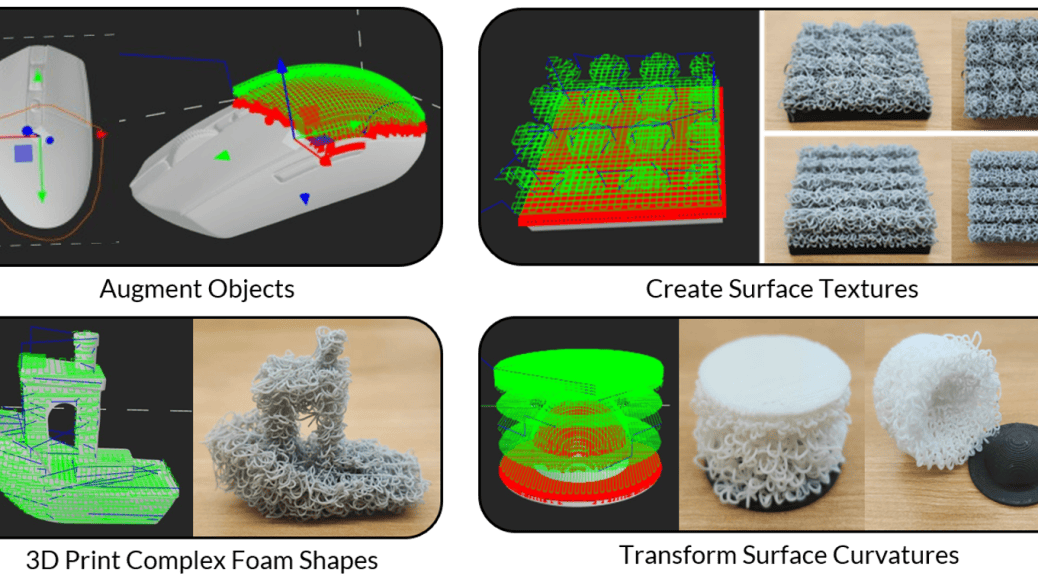
Combining soft-structure fabrication, direct-to-object augmentation, and embedded interactivity remains challenging, typically requiring specialized hardware, precise 3D scanning, or complex post-processing. AugPrint demonstrates how viscous thread printing (VTP) can bridge all three domains using an unmodified consumer-grade 3D printer. VTP leverages liquid rope coiling to deposit material from a high clearance, thereby inherently mitigating print head collisions on curved surfaces. The extruded filament remains viscous enough to passively conform to underlying geometries without requiring precise mesh alignment. We present a design tool that enables users to create gradient-density foam augmentations on curved surfaces with non-planar toolpath generation, stiffness control, and surface texturing. We also establish the viability of embedded pressure sensing using commercially available conductive TPU printed with VTP. We demonstrate these capabilities through end-to-end applications, including a pressure-mapping bike seat and a shock-absorbing microcontroller enclosure.